HOLD ON. HOLD ON. Some Things Last Forever
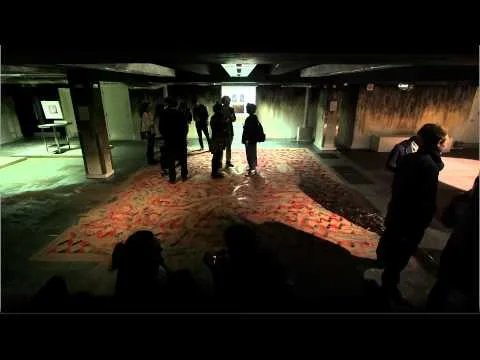
Time-lapse of the installation at the former BBC building, 35 Marylebone High Street, showing the sand floor as visitors walk across it.
HOLD ON. HOLD ON. Some Things Last Forever
Braden Labonte, 2013
Site-specific installation, 35 Marylebone High Street, London
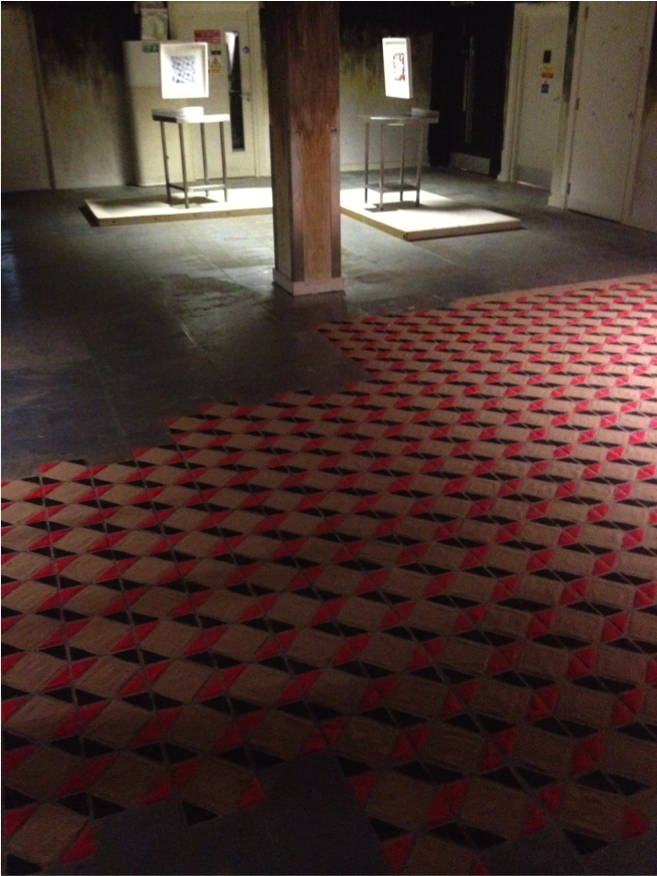
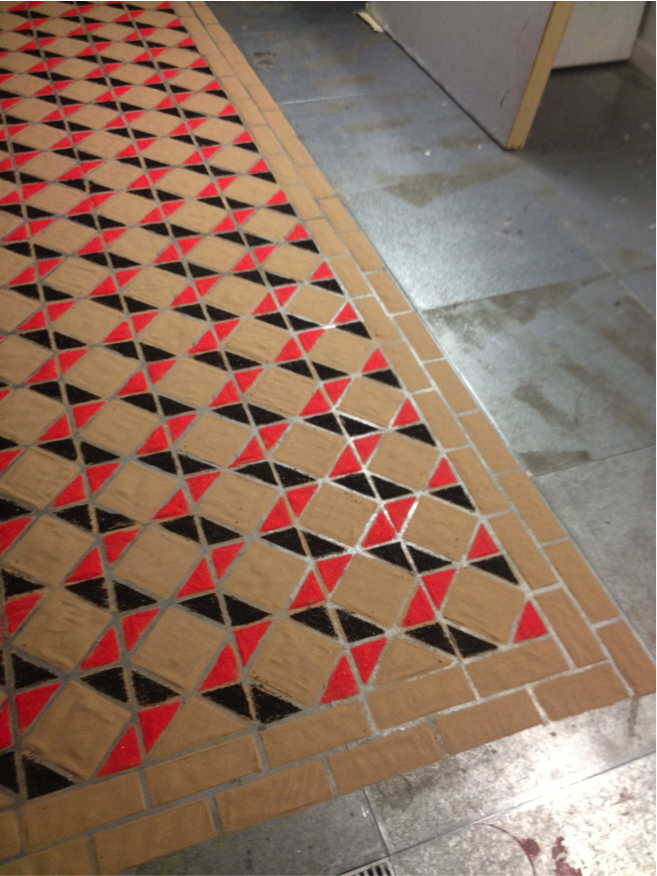
Over three days, Braden Labonte poured coloured sand onto the floor of an empty room at 35 Marylebone High Street to form a Victorian tile pattern. Near the back wall the pattern stopped, leaving a gap of about a metre and a half. On that wall hung a photograph of the finished installation, lit from above by a full-spectrum UV fluorescent bulb that stayed on for the whole exhibition.
On the opening night the work was complete. It never looked that way again. Every visitor who crossed the room shifted the sand, and footstep by footstep the pattern broke up into drifts and smears. More slowly, the light did the same to the photograph. UV exposure broke down its colours until the image shifted towards blue and began to disappear.
What drew me to the work was that it has two clocks running at once. The floor is erased by people, quickly and visibly, and each visitor becomes a co-author of its destruction whether they intend to or not. The photograph is erased by the building's own conditions, slowly and almost invisibly. The photograph is the work's own record, the document that should outlast the event, yet it is placed under the very light that destroys it. The piece asks what we expect a record to do, and who is responsible when it fails.
These questions run through my curatorial practice, from my research into user interaction with digital collections to my current work asking what counts as an archive. In Hold On the audience does not simply look at the work. They are the process by which it changes. There is no neutral way to walk through the room.
The site mattered too. The tiled floor Labonte recreated in sand recalls the domestic and institutional interiors the building had passed through. 35 Marylebone High Street has been a library and bookseller, a boarding school, a furniture store, a builder's headquarters, and for more than seventy years a home of the BBC. It housed the Radio Times, The Listener and BBC Radio London before the BBC left in 2009. The building is itself an accumulation of uses that were each, in their time, expected to last.
The building
First a library and bookseller, 35 Marylebone High Street became a boarding school in 1745. By 1832, as Oxford House, it was sold to the furniture storage firm Edward Tilbury and Company. The original building was demolished by 1931, when it became the headquarters of the builders Bovis, and by 1936 it belonged to the BBC. BBC Publications, the Radio Times and The Listener moved in first, followed by a fifth-floor concert hall, a music library and rehearsal rooms. The building was damaged in the Blitz in 1940 and not fully repaired until 1949. The BBC later expanded into 33–34 Marylebone High Street and Beaumont Mews, adding the Radio Times Hulton Picture Library and a BBC shop. From the 1970s No. 35 housed BBC Radio London, which became GLR in 1988 and BBC London in 2000. The BBC left in 2009.